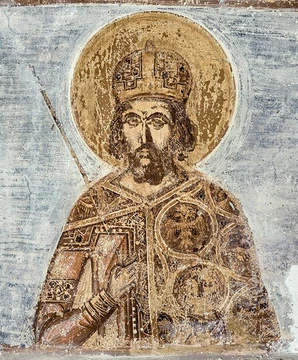
Constantius II
Roman emperor whose reign saw civil wars and religious strife.

Constantius II ruled as Roman emperor from 337 to 361. His time in power was defined by near-constant fighting: foreign wars against the Sasanian Empire and various Germanic tribes, and internal conflicts including civil wars, court scheming, and rebellions. His approach to religion stirred up tensions at home that outlasted his reign.
Born Flavius Julius Constantius on 7 August 317 in Sirmium (in modern-day Serbia), he was the third son of Constantine the Great and his second wife Fausta. His father made him a Caesar on 8 November 324, when he was seven. In 336, war broke out between Rome and Sassanid Persia after unrest in Armenia and strained relations between Constantine and King Shapur II. Constantine fell ill and sent Constantius east to take command. Before he arrived, the Persian general Narses overran Mesopotamia and captured Amida. Constantius attacked, defeated and killed Narses at the battle of Narasara, then recaptured Amida and reinforced its walls with large towers, also building a new fortress nearby called Antinopolis.
When Constantine died in early 337, Constantius hurried to Constantinople and gave his father a lavish burial in the Church of the Holy Apostles. Soon after, the army massacred many of his relatives—descendants of his grandfather Constantius Chlorus and Flavia Maximiana Theodora. Two uncles and seven cousins were killed, including Hannibalianus and Dalmatius. Only Constantius, his brothers Constantine II and Constans, and three cousins (Gallus, Julian, and Nepotianus) survived. The official story blamed the army, but writers like Ammianus Marcellinus, Zosimus, Libanius, Athanasius, and Julian all held Constantius responsible. Modern historian Burgess agrees, noting the lack of punishments, the sparing of women, the attempted damnatio memoriae, and the exile of Gallus and Julian as signs of a planned purge.
Constantius then met his brothers in Pannonia to divide the empire. He took the east—Greece, Thrace, Asia Minor, Syria, Egypt, and Cyrenaica—while Constantine II got Britain, Gaul, Spain, and Mauretania, and Constans received Italy, Africa, Illyricum, Pannonia, Macedonia, and Achaea. Constantius hurried to Antioch to resume the Persian war. While he was away in early 337, Shapur II attacked with a large army including war elephants, devastating Mesopotamia.
For the next decade, the costly and inconclusive war with Persia
- born
- 7 August 317, Sirmium, Pannonia
- died
- 3 November 361, Mopsuestia
- field
- Roman emperor
- nationality
- Roman
- known_for
- Promoting Arianism, banning pagan sacrifices, civil war against Magnentius, and conflict with the Sasanian Empire
Lore & Background
Constantius II was a son of Constantine the Great, elevated to Caesar on 8 November 324. After his father's death in 337, he became Augustus together with his brothers Constantine II and Constans. He promptly oversaw the massacre of his father-in-law, an uncle, and several cousins, consolidating his hold on power. The brothers divided the empire, with Constantius receiving Greece, Thrace, the Asian provinces, and Egypt. A costly and inconclusive war against Persia occupied most of his time, while his brothers warred in the west, leaving Constans sole ruler there until his assassination by the usurper Magnentius in 350.
Constantius waged civil war against Magnentius, defeating him at the battles of Mursa Major in 351 and Mons Seleucus in 353. After Magnentius's suicide, Constantius became sole ruler. He elevated his cousin Constantius Gallus to Caesar in 351 but executed him three years later, then promoted his last surviving cousin Julian to Caesar in 355. His military campaigns against Germanic tribes were successful, defeating the Alamanni in 354 and campaigning against the Quadi and Sarmatians in 357. The war against the Sasanians erupted again in 359, and Constantius traveled east in 360 to restore stability.
Reader's Guide
Constantius II's reign was pivotal in the late Roman Empire, characterized by relentless military pressure on multiple fronts and internal political instability. His wars against the Sasanian Empire, though often inconclusive, maintained Roman eastern defenses, while his victories over Germanic tribes secured the Danube frontier. The civil war against Magnentius, culminating in the bloody Battle of Mursa Major, drained imperial resources and set a precedent for costly internal conflicts. His religious policies—promoting Arianism, banning pagan sacrifices, and issuing laws against Jews—deepened religious divisions that persisted long after his death. The elevation and subsequent execution of his cousin Gallus, followed by the promotion of Julian, ultimately led to Julian's usurpation and a near civil war, which was only averted by Constantius's death. His legacy includes both the consolidation of imperial power after Constantine and the exacerbation of religious and political tensions that would shape the later empire.
Did You Know?
- Constantius II was born on 7 August 317 at Sirmium, Pannonia (modern Serbia).
- He oversaw the massacre of his father-in-law, an uncle, and several cousins after his father's death.
- He defeated the usurper Magnentius at the battles of Mursa Major (351) and Mons Seleucus (353).
- He died of fever on 3 November 361 in Mopsuestia, allegedly naming Julian as his rightful successor.
More in Emperors Of The Byzantine And Roman World 1-24
Spotted an error? Know more?
This is a living reference — every entry is fact-audited, and reader corrections feed straight into our audit queue. Suggest an edit · See this site's audit record