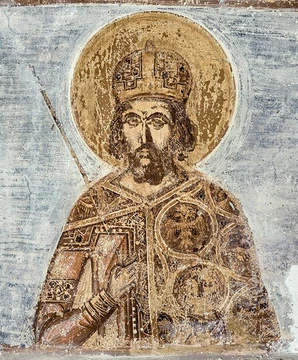
Constantine VIII
Longest-reigning de jure Byzantine emperor, whose sole rule saw decline.

Jaqeli · CC BY-SA 4.0
Constantine VIII (960 – 11/12 November 1028) was de jure Byzantine emperor from 962 until his death. He was the younger son of Emperor Romanos II and Empress Theophano, and served as nominal co-emperor for 66 years, making him de jure the longest-reigning Roman emperor since Augustus. His sole reign, beginning after the death of his brother Basil II in 1025, was marked by mismanagement and neglect due to his lifelong lack of interest in politics, statecraft, and the military.
- born
- 960
- died
- 11/12 November 1028
- field
- Byzantine emperor
- nationality
- Byzantine (Greek)
- known_for
- Longest-reigning de jure Roman emperor since Augustus; brief sole reign marked by decline
Lore & Background
Basil II died childless in 1025, leaving Constantine sole emperor at age 65. He continued his pleasure-seeking lifestyle, and the aristocracy extracted concessions, including the dropping of Basil's land laws. Unqualified men received senior posts, and Constantine responded to challenges with impulsive cruelty, including torture and blinding. His reign of less than three years has been described as an unmitigated disaster and the start of Byzantine decline. On his deathbed, without a male heir, he initially chose Constantine Dalassenos as successor, but advisors preferred Romanos Argyros, whom Constantine accepted. Romanos married Constantine's daughter Zoe and was crowned four days after Constantine's death on 11/12 November 1028.
Reader's Guide
Constantine VIII's significance lies in his record as the longest-reigning de jure Roman emperor since Augustus, with a nominal co-emperorship spanning 66 years. However, his sole reign of less than three years is widely regarded as a disaster for the Byzantine Empire. His lack of interest in governance led to mismanagement, the reversal of Basil II's land reforms, and the appointment of unqualified officials, which weakened the state. His impulsive cruelty alienated the elite, while his death without a male heir forced a succession through his daughter Zoe, setting the stage for the end of the Macedonian dynasty. Historians link his accession to the start of the empire's decline, as his neglect undermined the military and administrative systems built by his predecessors. His legacy is thus one of missed potential and systemic decay, contrasting sharply with the effective rule of his brother Basil II.
Did You Know?
- Constantine was de jure co-emperor for 66 years, the longest of any Roman emperor since Augustus.
- He participated in a military campaign in 989 that ended without combat.
- His daughter Eudokia became a nun after contracting smallpox.
- On his deathbed, he initially chose Constantine Dalassenos as successor but switched to Romanos Argyros on advisors' advice.
A Crown Worn for Sixty-Six Years
Constantine VIII holds a singular place in Roman imperial history: he occupied the throne for sixty-six years in total, making him the longest-reigning emperor de jure since Augustus himself. Yet for the vast majority of that span, he was merely a figurehead. Crowned as a co-emperor at just three years of age in 962, he was nominally sovereign alongside a rotating cast of actual rulers—first his father Romanos II, then his stepfather Nikephoros II Phokas, then his uncle John I Tzimiskes, and finally his elder brother Basil II. Each of these men wielded genuine power while Constantine simply endured the title. His lifelong disinterest in governance, military affairs, and statecraft meant he never sought to assert authority beyond the ceremonial. It was not until Basil's childless death in December 1025 that the sixty-five-year-old widower became the sole emperor, a position he had technically held for over six decades without ever truly exercising it. The irony of such a prolonged nominal reign, punctuated by a sole rule of barely three years, defines the strange arc of his life.
The Athlete and the Gourmand
In his youth, Constantine presented a strikingly different image from the passive co-emperor he would later become. Contemporaries recalled a tall, graceful, and athletic young man whose excellent speaking voice and natural command of rhetoric made him a presence in courtly life. He revived wrestling competitions, a sport he clearly championed, and devoted himself to the training and riding of horses—pursuits that spoke to a body oriented toward physical excellence rather than the study of statecraft. Alongside these active interests, Constantine cultivated a reputation as a gourmet and gourmand, indulging in extravagant pleasures that would, in his later decades, manifest as chronic gout so severe it impaired his ability to walk. His personal life was modest by imperial standards: he married Helena, a Byzantine aristocrat and daughter of Alypius, and their union produced three daughters—Eudokia, who took the veil after contracting smallpox; Zoe, who would reign as empress for twenty-two years; and Theodora, the last monarch of the Macedonian line. His only recorded military involvement came in a 989 campaign that concluded without a single engagement, underscoring how far his temperament lay from the warrior-emperor mold.
Three Years of Unraveling
The brief window between Basil II's death in December 1025 and Constantine's own passing in November 1028 has been characterized by historians as an unmitigated disaster and a fundamental break-up of the imperial system. The Byzantine aristocracy, long kept in rigorous check by Basil's iron governance, recognized in the new sole emperor a figure devoid of any semblance of moral fibre. They moved steadily to extract concessions, and their efforts bore fruit: unqualified individuals were installed in senior government posts, and the land laws Basil had enacted were abandoned under pressure from the powerful families of Anatolia. Constantine himself, content to wallow in extravagant pleasures, offered little resistance to this dismantling. Yet he was not without a dangerous edge. When he felt challenged or began to suspect conspiracies among the elite, his response was impulsive cruelty—condemned nobles faced torture or sentences of blinding. The cumulative effect of his mismanagement and neglect was so severe that the broader decline of Byzantine military power has been traced directly to his accession. A reign of fewer than three years thus left a wound that outlasted the dynasty itself.
The Last Macedonian and His Heirs
Constantine VIII died on 11 or 12 November 1028 without a single son, leaving the Macedonian dynasty's future entirely in the hands of his daughters. On his deathbed, the ailing emperor named Constantine Dalassenos, Duke of Antioch, as his successor—a senior aristocrat from one of the few patrician families that had remained unswervingly loyal to the Macedonian line. Dalassenos was summoned from his estates in the Armeniac Theme, with the understanding that he would cement his claim by marrying the emperor's daughter Zoe. Yet before the duke could complete his journey to Constantinople, the political winds shifted. The emperor's advisors identified Romanos Argyros as a preferable candidate, one who appeared likely to be a weak ruler they could manipulate. Characteristically, Constantine acquiesced to their preference without resistance. Romanos was compelled to divorce his existing wife and wed Zoe; the ceremony took place on 12 November, and his coronation followed four days later. The dynasty's thread continued through Zoe, who would reign for twenty-two years, and briefly through Theodora, whose eighteen-month rule marked the final chapter of the Macedonian line.
Gallery
More in Emperors Of The Byzantine And Roman World 1-24
Spotted an error? Know more?
This is a living reference — every entry is fact-audited, and reader corrections feed straight into our audit queue. Suggest an edit · See this site's audit record