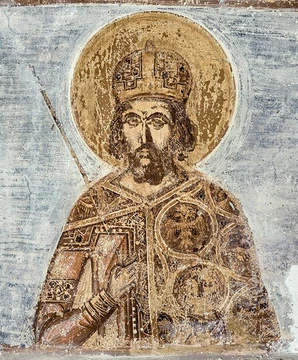
Basil I
Byzantine emperor who founded the Macedonian dynasty and reformed law.

Unknown, 13th-century author · Public domain
Basil I, known as "the Macedonian," ruled the Byzantine Empire from 867 until his death in 886. He was born around 811 to peasant parents in the theme of Macedonia, though some scholars place his birth in the 830s, which might explain his later rise under the young Emperor Michael III. His father’s name is given as either Bardas or Constantine, his mother was Pankalo, and his paternal grandparents were Maiktes or Leo. His ethnic background is uncertain and debated; an elaborate genealogy during his reign claimed descent from Armenian Arsacid kings, Alexander the Great, and Constantine the Great. Armenian historians say he came from the village of Thil in Taron, while Persian writers called him and his mother Saqlabi, a term often meaning Slav. The scholarly consensus is that his father was probably Armenian, settling in Byzantine Thrace, and his mother’s name suggests Greek origins. Basil may have spoken Armenian as well as Greek, and his close associates were mostly Armenian.
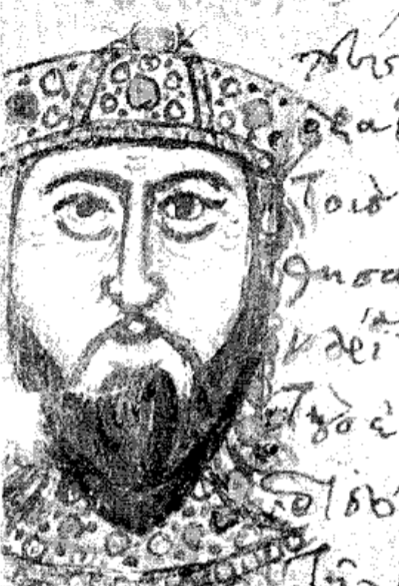
As a child, Basil was reportedly captured by the Bulgarian Khan Krum in 813 and held until 836, when he escaped to Byzantine Thrace. He then entered the service of Theophilitzes, a relative of Caesar Bardas, as a groom. While in Patras, he gained the favor of a wealthy woman named Danielis, who gave him a fortune. He caught Michael III’s attention by taming horses and defeating a Bulgarian champion in wrestling, soon becoming the emperor’s companion, confidant, and bodyguard. One contemporary described him as heavy-set, with joined eyebrows, large eyes, a broad chest, and a downcast expression.
On Michael’s orders, Basil divorced his wife Maria and married Eudokia Ingerina, Michael’s mistress, around 865. Michael also offered him his sister Thekla as a mistress, but Basil ended the affair in 870 after discovering her infidelity. In 866, Basil convinced Michael that his uncle Bardas was plotting against the throne, and with Michael’s approval, Basil murdered Bardas on 21 April. Basil was then made Caesar and crowned co-emperor on 26 May 866, possibly after being adopted by Michael. It was widely believed that Leo VI, Basil’s successor, was actually Michael’s son; Basil himself seems to have believed this and hated Leo, but the adoption and co-emperorship gave Leo a legitimate imperial parent. When Leo was born, Michael celebrated with chariot races and warned Basil not to overstep his
- born
- 811 (or sometime in the 830s in some scholarly estimates)
- died
- 29 August 886
- field
- Emperor, lawgiver, military commander
- nationality
- Byzantine (ethnic origin uncertain: possibly Armenian, Slavic, or Greek)
- known_for
- Founder of the Macedonian dynasty; initiator of the Basilika legal code; subjugation of the Paulicians; restoration of Byzantine power in Italy
Lore & Background
Basil was born to peasant parents in late 811 (or the 830s) at Chariopolis in the Byzantine theme of Macedonia. His ethnic origin is unknown and debated; some sources suggest Armenian, Slavic, or Greek ancestry. He spent part of his childhood in captivity in Bulgaria after being carried off by Khan Krum in 813, escaping to Byzantine territory in 836. He entered the service of Theophilitzes as a groom, then gained the favour of the wealthy Danielis in Patras, who endowed him with a fortune. His abilities as a horse tamer and a victory over a Bulgarian champion in wrestling brought him to the notice of Emperor Michael III, who made him companion, confidant, and bodyguard. On Michael's orders, Basil divorced his wife Maria and married Eudokia Ingerina, Michael's mistress, around 865. Basil murdered Michael's uncle Bardas in 866, was crowned co-emperor, and then assassinated Michael in 867 to become sole ruler.
Reader's Guide
Basil I's significance lies in founding the Macedonian dynasty, which would rule Byzantium for nearly two centuries. Despite his violent rise to power, he proved an effective administrator and military leader. His most enduring legacy is the initiation of a complete overhaul of Byzantine law, collected in the Basilika, which remained the empire's legal code until the Ottoman conquest. On the foreign front, he subjugated the heretical Paulicians in 872 and pursued an active policy in the West, allying with Carolingian emperor Louis II against the Arabs, leading to a new period of Byzantine domination in Italy. His reign also saw good relations with Rome and the construction of the Nea Ekklesia cathedral. He died in a hunting accident in 886 and was succeeded by his son Leo VI, rumored to have been the son of Michael III. The uncertainty about his ethnic origins and the elaborate genealogy claiming descent from Arsacid kings, Alexander the Great, and Constantine the Great reflect the complex identity politics of the Byzantine court.
Did You Know?
- Basil I was nicknamed 'the Macedonian' but was born in the theme of Macedonia in Thrace, not the region of modern North Macedonia.
- He spent part of his childhood as a captive in Bulgaria after being carried off by Khan Krum in 813.
- His legal code, the Basilika, remained Byzantine law until the Ottoman conquest.
- He died in a hunting accident in 886.
From Peasant to Imperial Confidant
Basil I entered the world around 811 (some scholars place it in the 830s) at Chariopolis in the theme of Macedonia, son of a peasant couple named Bardas and Pankalo. His path to the imperial court was far from inevitable. After a period possibly spent in Bulgarian captivity as a child, he found work as a groom under Theophilitzes, a relative of the Caesar Bardas. A visit to Patras brought him into the household of a wealthy woman, Danielis, who endowed him with a fortune. His skill as a horse tamer and his victory over a Bulgarian wrestling champion caught the eye of Emperor Michael III, who drew him into his inner circle as companion, confidant, and bodyguard. Around 865, at Michael's direct command, Basil divorced his wife Maria and wed Eudokia Ingerina, the emperor's own mistress. In April 866 he helped orchestrate the killing of Bardas, Michael's uncle, then was elevated to kaisar and crowned co-emperor on 26 May 866. A man of no formal education had become, in a matter of years, the second most powerful figure in the Byzantine Empire.
The Night Michael III Fell
By late 867, Basil's position at court was under serious threat. Michael III had begun favoring another courtier, Basiliskianos, and threatened to invest him with the imperial title—a move that would have stripped Basil of his hard-won influence. Rather than await his own demotion, Basil chose to act first. On the night of 24 September 867, Michael and Basiliskianos were insensibly drunk after a banquet at the palace of Anthimos. Basil, accompanied by a small group including his father Bardas, his brother Marinos, and his cousin Ayleon, gained entry to the chamber. The locks had been tampered with beforehand, and no guards had been posted. Both men were put to the sword. Because Basil already held the title of co-emperor, Michael's death made him the sole ruling basileus by automatic succession. The assassination ended the Amorian dynasty and inaugurated the Macedonian line, a dynasty that would rule Byzantium for the next two centuries.
Governance, Law, and Military Achievement
Despite lacking formal education, Basil proved a capable and respected sovereign. His most enduring domestic contribution was a sweeping overhaul of Byzantine law, a project he initiated and his successor Leo VI continued, eventually crystallizing into the codex known as the Basilika. On the military front, he achieved a decisive victory over the Paulicians, a heretical sect that had long troubled the empire, subjugating them in 872. His foreign policy extended westward as well: he forged an alliance with the Carolingian emperor Louis II against the Arab threat, a partnership that ushered in a renewed period of Byzantine dominance over Italian territories. These accomplishments—legal reform, internal security, and strategic diplomacy—demonstrated that a ruler of peasant stock could govern with the same authority as any aristocratic predecessor. His reign, though relatively short, set institutional and military precedents that shaped the empire for generations to come.
Origins, Dynasty, and Succession
Basil's ethnic background has generated centuries of scholarly debate. During his reign, an elaborate genealogy was fabricated claiming descent from the Arsacid kings of Armenia, Alexander the Great, and Constantine the Great. Armenian historians place his origins in the village of Thil in Taron, while Persian writers label him and his mother Saqlabi—a term usually indicating Slavic identity. His mother's name suggests Greek heritage on that side. The general consensus points to an Armenian father settled in Byzantine Thrace, and Basil's close associates were predominantly Armenian, with some suggesting he spoke the language. After his death in a hunting accident on 29 August 886, he was succeeded by his son Leo VI, though widespread rumour held that Leo was actually Michael III's child. Basil himself reportedly shared this suspicion and harbored resentment toward Leo. Yet the promotion to co-emperor had given the boy a legitimate imperial parent and secured his succession. The Macedonian dynasty thus endured, its founding myth inseparable from the enigma of its first emperor's bloodline.
Gallery
Frequently Asked Questions
Who is Basil I?
Basil I, nicknamed 'the Macedonian,' was a Byzantine emperor who reigned from 867 until 886. He rose from peasant origins in the theme of Macedonia to become the founder of the Macedonian dynasty.
How did Basil I go from peasant to emperor?
Born around 811 to a peasant father (named either Bardas or Constantine) and mother Pankalo, Basil climbed the ranks under the young Emperor Michael III. His ethnic background remains uncertain, with scholars debating whether he was Armenian, Slavic, or Greek.
What was Basil I's most important legal achievement?
He commissioned the Basilika, a comprehensive codification and reform of Byzantine law that reorganized centuries of accumulated legal precedent. This code became a cornerstone of Byzantine jurisprudence for generations to come.
How did Basil I's reign end?
Basil I died on 29 August 886, bringing his roughly nineteen-year rule to a close. He was succeeded by his son, who continued the Macedonian dynasty he had established.
Why is Basil I considered important in Byzantine history?
As the founder of the Macedonian dynasty, he launched a line of emperors that would dominate Byzantine politics for over two centuries. His reign also saw the subjugation of the Paulician heretics and a significant restoration of Byzantine military and political power in Italy.
More in Emperors Of The Byzantine And Roman World 1-24
Spotted an error? Know more?
This is a living reference — every entry is fact-audited, and reader corrections feed straight into our audit queue. Suggest an edit · See this site's audit record