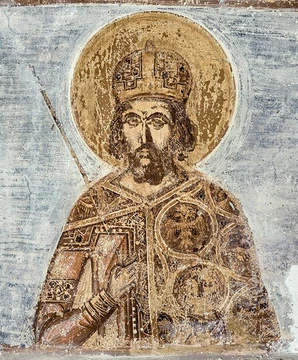
Caracalla
Roman emperor who granted citizenship to all free inhabitants.

Marcus Aurelius Antoninus, born Lucius Septimius Bassianus and better known by his nickname Caracalla, was Roman emperor from 198 to 217 AD. He first served as nominal co-emperor under his father, Septimius Severus, and then ruled alone after 211 AD. A member of the Severan dynasty, Caracalla is remembered for the Antonine Constitution, which granted Roman citizenship to most free inhabitants of the empire, and for his construction of the Baths of Caracalla.
- born
- 4 April 188
- died
- 8 April 217
- field
- Roman emperor
- nationality
- Roman
- known_for
- Antonine Constitution (Edict of Caracalla), Baths of Caracalla, antoninianus currency, murder of his brother Geta
Lore & Background
Caracalla was born in Lugdunum, Gaul (now Lyon, France), on 4 April 188 to Septimius Severus and Julia Domna, giving him Punic paternal ancestry and Arab maternal ancestry. He had a younger brother, Geta. At age seven, he was renamed Marcus Aurelius Antoninus as part of his father's attempt at union with the Antonine dynasties. He became known by the nickname Caracalla after a Gallic hooded tunic he habitually wore. His father proclaimed him co-ruler in 198, and his brother Geta co-ruler in 209. After their father's death in 211, the two brothers briefly shared power, but Caracalla soon had Geta murdered by the Praetorian Guard and became sole ruler. Julia Domna had a significant share in governance, as Caracalla found administration mundane.
Reader's Guide
Caracalla's reign is significant for the Antonine Constitution (Constitutio Antoniniana), which extended Roman citizenship to all free inhabitants of the empire except the dediticii. This edict gave all enfranchised men Caracalla's adopted praenomen and nomen: 'Marcus Aurelius'. Other landmarks include the construction of the Baths of Caracalla, the second-largest bathing complex in Rome, and the introduction of the antoninianus, a double denarius. His reign featured domestic instability and external invasions by Germanic peoples. In 216, he began a campaign against the Parthian Empire but was assassinated by a disaffected soldier in 217 before completing it. Ancient sources portray Caracalla as a cruel tyrant; contemporaries Cassius Dio and Herodian present him as a soldier first and an emperor second. Modern works continue to depict him as one of the most tyrannical Roman emperors.
Did You Know?
- Caracalla's birth name was Lucius Septimius Bassianus.
- He was nicknamed Caracalla after a Gallic hooded tunic he habitually wore.
- He ordered the murder of his brother Geta in 211 and then massacred an estimated 20,000 of Geta's supporters.
- He introduced a new Roman currency called the antoninianus, a sort of double denarius.
Frequently Asked Questions
Who is Caracalla?
Caracalla, born Lucius Septimius Bassianus in 188 AD, was a Severan-dynasty Roman emperor who held the title from 198 to 217 AD. He first served as a nominal co-ruler beside his father Septimius Severus and assumed sole authority in 211 AD.
What was the Edict of Caracalla (Antonine Constitution)?
Issued in 212 AD, this decree extended full Roman citizenship to virtually every free inhabitant of the empire, regardless of province. It remains one of the widest-reaching legal reforms in Roman history and permanently altered the relationship between the state and its subjects.
Where does the nickname 'Caracalla' come from?
It refers to a heavy woolen tunic of the same name that he habitually wore, even at formal court functions. The garment became his lasting epithet, eclipsing his birth name Lucius Septimius Bassianus in all later records.
How did Caracalla's reign come to an end?
He was stabbed to death by soldiers on 8 April 217 AD while on campaign in the east. The assassination was followed by a bloody purge in which his mother Julia Domna and several close associates were also put to death.
What is the antoninianus and how is it linked to Caracalla?
The antoninianus was a silver coin struck at roughly one-and-a-half denarii in value, first minted during his reign. It went on to serve as a standard Roman denomination for centuries and stands as one of his most enduring economic legacies.
More in Emperors Of The Byzantine And Roman World 1-24
Spotted an error? Know more?
This is a living reference — every entry is fact-audited, and reader corrections feed straight into our audit queue. Suggest an edit · See this site's audit record