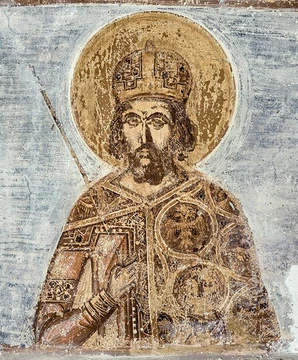
Constantine XI Palaiologos
Last Byzantine emperor, died defending Constantinople in 1453.

Constantine XI Dragases Palaiologos (8 February 1404 – 29 May 1453) was the final Byzantine emperor, ruling from 23 January 1449 until he died fighting during the Ottoman conquest of Constantinople. His death ended the Eastern Roman Empire, a state that traced its origins to when Constantine the Great made Constantinople the Roman capital in 330.
The fourth son of Emperor Manuel II Palaiologos and the Serbian noblewoman Helena Dragaš, Constantine took his second surname from his mother’s family. Little is recorded about his early years, but from the 1420s onward he repeatedly proved himself a capable military commander. Contemporary sources suggest he was primarily a soldier, though he was also a trusted administrator. His older brother, Emperor John VIII, appointed him regent twice—during John’s absences from Constantinople in 1423–1424 and again in 1437–1440. In 1427–1428, Constantine and John repelled an attack on the Morea (the Peloponnese) by Carlo I Tocco, ruler of Epirus. The following year, Constantine was made Despot of the Morea, governing alongside his brothers Theodore and Thomas. Together they extended Byzantine control over nearly the entire Peloponnese for the first time since the Fourth Crusade, more than two centuries earlier, and rebuilt the ancient Hexamilion wall to defend the peninsula. In 1444–1446, Constantine personally led a campaign into Central Greece and Thessaly, attempting to reassert Byzantine authority there, though it ultimately failed.
When John VIII died childless in October 1448, Constantine—his favored successor—was proclaimed emperor on 6 January 1449. His brief reign faced three major problems. First, he had no heir. Despite efforts by his friend George Sphrantzes to arrange a marriage, Constantine died unmarried. Second, religious conflict divided what remained of the empire. Constantine and John both supported the union of the Greek Orthodox and Catholic Churches agreed at the Council of Florence, hoping to secure military aid from Catholic Europe. But much of the Byzantine populace, led by Mark of Ephesus, opposed the union. Third, and most critically, the Ottoman Empire had completely surrounded Constantinople by 1449. In April 1453, Sultan Mehmed II besieged the city with an army perhaps as large as 80,000 men. The defenders likely numbered less than a tenth of that, yet Constantine refused to abandon Constantino
- born
- 8 February 1404
- died
- 29 May 1453
- field
- Military general, administrator, emperor
- nationality
- Byzantine (Roman)
- known_for
- Last reigning Byzantine emperor; died defending Constantinople during its fall to the Ottoman Empire
Lore & Background
Constantine was the fourth son of Emperor Manuel II Palaiologos and Serbian noblewoman Helena Dragaš. Little is known of his early life, but from the 1420s onward, he repeatedly demonstrated great skill as a military general. Based on his career and surviving contemporary sources, Constantine appears to have been primarily a soldier. This does not mean that Constantine was not also a skilled administrator: he was trusted and favored to such an extent by his older brother, Emperor John VIII Palaiologos, that he was designated as regent twice during John VIII's journeys away from Constantinople in 1423–1424 and 1437–1440. In 1427–1428, Constantine and John fended off an attack on the Morea (the Peloponnese) by Carlo I Tocco, ruler of Epirus, and in 1428 Constantine was proclaimed Despot of the Morea and ruled the province together with his older brother Theodore and his younger brother Thomas. Together, they extended Roman rule to cover almost the entire Peloponnese for the first time since the Fourth Crusade more than two hundred years before and rebuilt the ancient Hexamilion wall, which defended the peninsula from outside attacks. Although ultimately unsuccessful, Constantine personally led a campaign into Central Greece and Thessaly in 1444–1446, attempting to extend Byzantine rule into Greece once more.
Reader's Guide
Constantine XI Palaiologos is significant as the final ruler of the Eastern Roman Empire, whose death in battle at the fall of Constantinople on 29 May 1453 ended a continuous imperial tradition dating to 330. His reign, though brief, confronted three main issues: the lack of an heir (he died unmarried), religious conflict over the union of Greek Orthodox and Catholic Churches (which he supported, following the Council of Florence), and the overwhelming threat of the Ottoman Empire under Sultan Mehmed II. Despite being vastly outnumbered—the Ottoman army perhaps numbered 80,000 men against fewer than a tenth that number of defenders—Constantine refused to abandon the city and died in a last stand. No reliable eyewitness accounts of his death survived, but most historical accounts agree he died fighting. His legacy is cemented in Greek folklore as the 'Marble Emperor,' a legendary figure turned to marble and hidden beneath the Golden Gate, awaiting a call from God to restore the empire. The coincidence of the city's foundation by Constantine the Great and its loss under another Constantine was seen by some as fulfilling a destiny parallel to that of Old Rome.
Did You Know?
- Constantine was the fourth son of Emperor Manuel II Palaiologos and Serbian noblewoman Helena Dragaš.
- He was designated regent twice during his brother John VIII's absences from Constantinople, in 1423–1424 and 1437–1440.
- Constantine died unmarried despite attempts by his friend George Sphrantzes to find him a wife.
- In later Greek folklore, he became known as 'The Marble Emperor,' reflecting a legend that he was turned to marble and hidden beneath the Golden Gate.
More in Emperors Of The Byzantine And Roman World 1-24
Spotted an error? Know more?
This is a living reference — every entry is fact-audited, and reader corrections feed straight into our audit queue. Suggest an edit · See this site's audit record