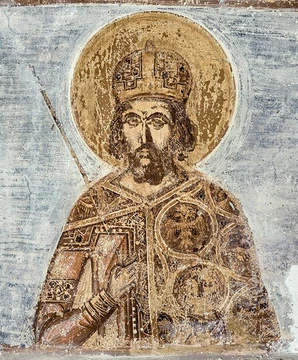
Appius Claudius Caecus
First Roman public figure with historically traceable life.

Appius Claudius Caecus (fl. c. 312–279 BC) was a statesman and writer from the Roman Republic, best known for two major building projects: the Appian Way, the first major Roman road, and the first aqueduct in Rome, the Aqua Appia. He is the first Roman public figure whose life can be traced with some historical certainty, and he is also credited with the authorship of a juristic treatise, a collection of moral essays, and several poems, making him one of Rome's earliest literary figures.
- floruit
- c. 312–279 BC
- field
- Statesman, writer, censor, consul, praetor
- nationality
- Roman Republic
- known_for
- Appian Way, Aqua Appia, constitutional reforms, early Roman literature
Lore & Background
Appius Claudius Caecus, originally called Appius Claudius Crassus, was born into the patrician clan of the Claudii. His father was Gaius Claudius Inregillensis, known only for being appointed dictator in 337 BC and immediately resigning. Caecus first came to prominence with his election as censor in 312 BC, a position he held for five years. During his censorship, he introduced controversial reforms: he increased the voting power of the poor and landless, admitted lower-class citizens to the Senate, and was the first censor to draw up a formal list of senators. These reforms massively increased the prestige of the censorship, though they were partially undone by the resentful nobility.
Reader's Guide
Appius Claudius Caecus is significant as a transformative figure in early Roman history, whose building projects—the Appian Way and the Aqua Appia—had lasting infrastructural impact. His constitutional reforms, though controversial and partially reversed, shifted the balance of power and elevated the censorship. As a literary pioneer, he authored some of Rome's earliest known prose and verse. His later speech against peace with Pyrrhus demonstrated his political influence. Modern scholars interpret him variously as a revolutionary, reactionary, would-be tyrant, or great reformer, reflecting the wide divergence in ancient sources, including possible smear campaigns by the Fabian family. His legacy endures as a symbol of both innovation and political strife.
Did You Know?
- He became blind from old age, earning the surname Caecus (Latin for 'blind').
- He delivered a speech to the Senate successfully opposing peace with King Pyrrhus of Epirus.
- He was the first censor to draw up a formal list of senators.
- He is credited with ending the use of the letter Z in Latin orthography.
More in Emperors Of The Byzantine And Roman World 1-24
Spotted an error? Know more?
This is a living reference — every entry is fact-audited, and reader corrections feed straight into our audit queue. Suggest an edit · See this site's audit record